10 Open-Source GitHub Repos That Can Replace Your Paid Subscriptions
Notion, Figma, Calendly, Mailchimp, and six more popular paid tools all have free, open-source, self-hosted alternatives on GitHub. Here is what to swap and why.
Most of the SaaS tools you pay a monthly seat fee for have a free, open-source twin sitting on GitHub. Same core job, no per-seat pricing, and because the whole thing is open source, you can hand the source code to an AI agent and ask it to add exactly the one feature you actually need instead of paying for a bloated plan you'll only use 10% of.
This list is built off a roundup Andrew Warner put together on his YouTube channel, pairing ten popular paid tools with their open-source replacement. We pulled the ten tools out, checked the numbers, and wrote up what each one actually does and where it's worth switching.
Notion → AppFlowy
Notion is where most teams keep their entire company memory: every spec, every retro, every doc. The catch is the per-seat pricing climbs fast once you add AI seats for the whole team, whether or not everyone actually uses them. AppFlowy is an open-source alternative built in Flutter and Rust, in active development since 2021, with over 75,000 GitHub stars and more than 100 releases, so this isn't a weekend project, it's a real product with a real desktop app.
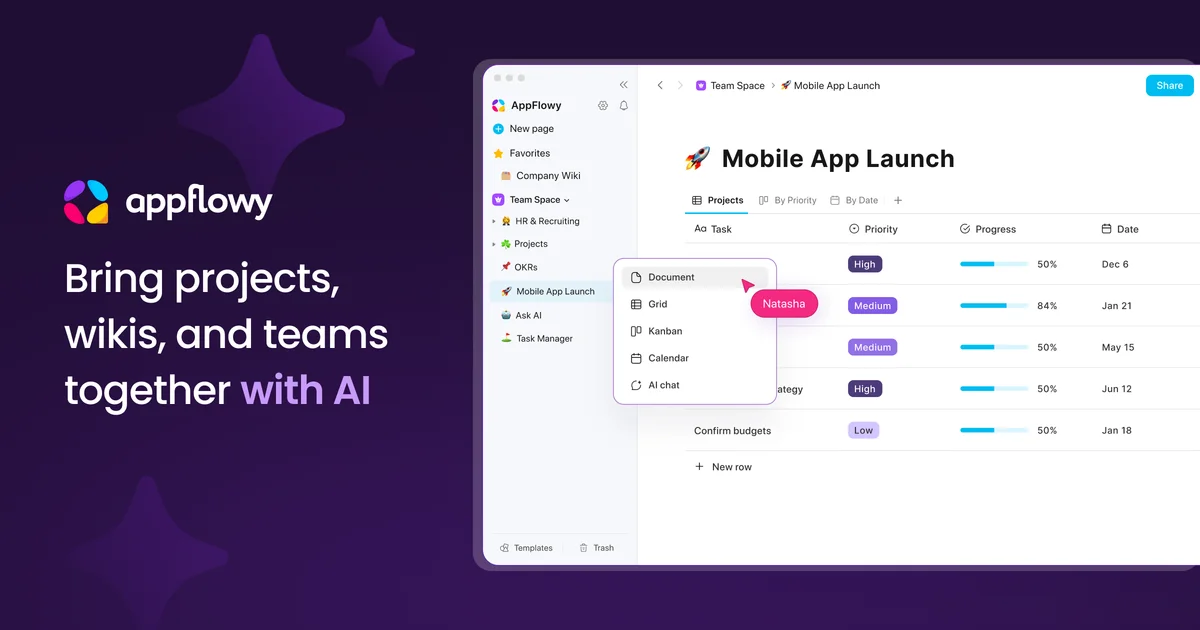
If your team's Notion bill keeps creeping up because of AI seats nobody's using, this is worth a real look before you renew.
Google Photos → Immich
Google Photos is genuinely good, but every photo you upload carries metadata Google keeps: where it was taken, when, sometimes down to the exact coordinates of your house. And you're paying rent to keep it stored there.
Immich is a self-hosted alternative that a developer started and a full team has since picked up. It has over 110,000 GitHub stars, 463+ contributors, and 300+ releases, this is shipped like a funded company's product, just without anyone metering your usage. It handles automatic backup from iOS and Android, selective album backup, on-device facial recognition, and search by face, place, or description.

One real caveat: self-hosting means backups are on you. Immich's own docs open with a reminder to follow the 3-2-1 backup rule, three copies, two different media, one offsite, because there's no Google quietly doing that for you anymore.
DocuSign → Documenso
DocuSign's cheapest paid plan caps you at five envelopes a month, for $11. Five, not five hundred. For most solo consultants sending contracts regularly, that's a real bottleneck for a document-signing tool.
Documenso was announced in 2022 by two developers and shipped its first version in 2023. It supports real PDF signatures built on standard PDF signing libraries, gives you a self-hosted audit trail on your own server, one-click deploys, and templates. Like the others on this list, it also has a paid enterprise tier, that's where the company's business model sits, but the core signing functionality is free and yours to run.
Miro → Excalidraw
Miro charges per member just to draw a box with an arrow coming out of it, and once a free trial ends, your board gets locked rather than deleted, effectively held hostage until you pay.
Excalidraw is released under the MIT license and has grown past 120,000 GitHub stars, a huge number for a whiteboard tool. You can go to its site and start drawing immediately, no account, no email address required. It has an infinite canvas, hand-drawn style rendering, dark mode, and exports to PNG, SVG, or clipboard.

One thing worth knowing: real-time collaboration and end-to-end encryption are features of the hosted excalidraw.com app specifically. The open-source repository is the editor itself, which you can embed or build on freely, but running your own full collaborative server is a bigger job than running the editor alone.
Figma → Penpot
Figma's per-seat pricing is a common complaint among small teams, and developers who just need to inspect a design have historically had to pay for the privilege. Penpot comes from a company in Spain and has been in development since December 2015, over a decade of work, free for every seat including developers.
It has an inspection mode that hands developers usable code straight from the design, and a meaningful technical difference from Figma: Penpot builds files on open web standards instead of a proprietary format.
Calendly → Cal.com
Calendly charges per seat just for people to book time on your calendar, a strange thing to pay for when the value is really just a shared link.
Cal.com comes from the same team behind cal.com and open-sources everything except its enterprise edition. You get bookable event types with custom availability, connections to Google Calendar, Microsoft 365, Zoom, and HubSpot, and it's self-hosted by default on your own domain, so you can bring your own branding rather than a generic Calendly link.
Mailchimp → Listmonk
Mailchimp's free tier caps out around 250 contacts, and pricing climbs with every subscriber you add. You build the audience, they collect the growing bill.
Listmonk is a self-hosted newsletter tool with no per-subscriber pricing at all, you send to as many people as your own server can handle. It ships as a single binary, no complicated setup, with a dashboard for your lists and campaigns, open and click tracking, and your choice of sending provider like SendGrid or Amazon SES. The one thing it doesn't include is actual email delivery, you'll still need a sending service, but those cost pennies compared to Mailchimp's per-subscriber pricing.
Bitly → Dub
Bitly's free plan has shrunk to five links a month, and its top paid tier runs $300 a month for 3,000 links. For a service that's mostly just shortening URLs, that's a steep climb.
Dub launched in August 2022 and is already used by companies like Twilio, Buffer, Framer, Perplexity, and Vercel. It goes beyond shortening, giving you real conversion tracking (not just click counts) and affiliate program support, so you can see when a click actually turns into a customer. Dub runs on an open-core model: almost all of the code is free, with a small set of enterprise features held back under a separate commercial license.

TeamViewer → RustDesk
TeamViewer allows personal use, but its "commercial use detected" flag has a habit of cutting off sessions that were never commercial in the first place, like helping a family member with their printer.
RustDesk is an open-source remote desktop tool written in Rust, built specifically for self-hosting. It supports Windows, Linux, macOS, Android, and iOS, connects computer to computer directly through your own self-hosted relay so the connection never touches a third party's servers, and includes file transfer between machines.
Wispr Flow → Fluid Voice
Wispr Flow is a popular voice dictation tool, but it sends your voice to a server you don't own and caps free usage around 2,000 words a week, roughly 15 minutes of talking before you're asked to pay.
Fluid Voice is a much newer project, first released in September 2025, and it's already past 10,000 GitHub stars. Everything runs directly on your own computer instead of a cloud server, so it's faster and your voice never leaves your machine. It shows a live preview of what it's transcribing as you talk, supports a global hotkey, and originally launched Mac-only before a Windows build followed shortly after.
The real advantage isn't just free
Every tool on this list is open source, which means the code is sitting right there for you to read, fork, and modify. That's the part worth paying attention to if you're already using AI coding agents day to day: instead of paying for a feature a SaaS company decided to gate behind a higher tier, you can point an agent at the actual source and ask for exactly the version you need.
Most of these are also small enough to self-host on the same box you're already running other tools on. If you haven't set that up yet, our guide on hosting multiple apps on one VPS with Coolify covers exactly that, and if you're weighing self-hosted automation more broadly, we've also written about self-hosting your own workflow automation.

Shubho Dey
Founder, Indish Marketer
Shubho runs Indish Marketer, building automation and AI agent systems for coaches, consultants, and service providers. He writes about the tools and workflows he builds and uses himself.